T-Mobile Fiber: eero
- 4.9
- Rating
- 50.00K
- Installs
- Free
- Price

 Analysis by App-foxy
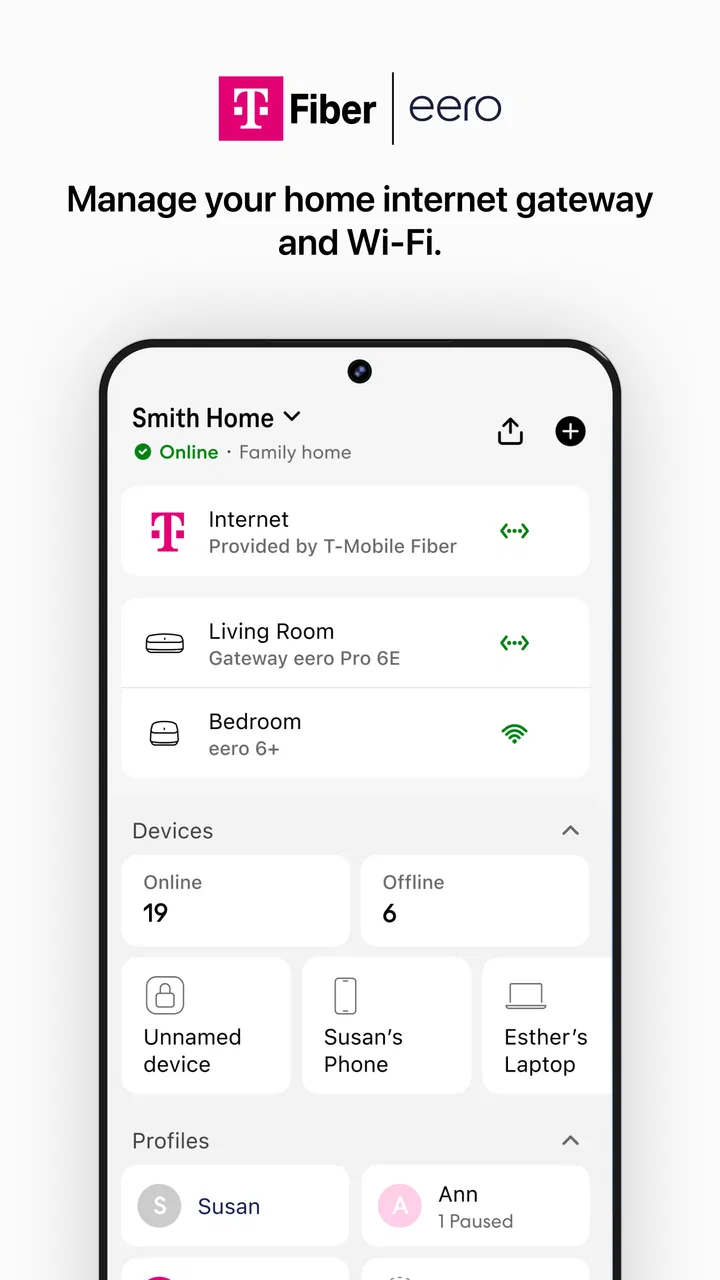
Managing home internet equipment is usually the kind of task I would rather finish quickly than explore. T-Mobile Fiber: eero makes that job more approachable by putting eero device management in a mobile app built for T-Mobile Fiber customers. After spending time with it, my main impression is simple: it is most useful when you want a clear, phone-based way to keep track of your compatible eero setup without treating networking like a technical hobby.
This is a free personalization app from eero LLC, with an Everyone age rating. It is available for devices running Android 9 or later, and its current version is 26.5.1.200041. The app has reached over ten thousand installs and holds a 5.0 average from around one and a half thousand ratings, which suggests that its focused audience generally finds it dependable.
That focus is also the first thing to understand. This is not a general-purpose Wi-Fi utility for every router brand. It is intended for managing eero devices connected to T-Mobile Fiber service. If that describes your home, the app can be a convenient control point. If you use another provider or a different router system, its usefulness drops sharply.
You May Also Like

 Blood Strike: 2.5 Anniversary
Blood Strike’s Loadouts Turn Every Drop Into a Tactical Gamble
A close look at Blood Strike’s custom loadouts: how fast access to signature weapons reshapes its battle royale rhythm, rewards preparation, and narrows the gap between fights.

 Pandora - Music & Podcasts
Pandora’s Music Is Easy to Start, but Harder to Recover
Pandora’s strength is its low-effort path from a seed to a station. Its weak spot is how much confidence it asks you to place in connection, setup, and quiet recovery.

 8 Ball Pool
 Is Built on Rivalries, Rematches, and Routine
A close look at the rivalries, rematches, shared routines, and unanswered safety questions that turn a quick pool match into a persistent mobile community.

 Samsung Music
’s Quiet Strength Is Playing What You Already Own
Its reach comes less from spectacle than from dependable access to a personal library. That simplicity is both the app’s strongest retention engine and its ceiling.

 AccuWeather: Weather Radar
AccuWeather Review: A Quick, Clear Forecast for Everyday Decisions
For everyday plans, the best forecast is the one you can understand quickly. AccuWeather makes rain timing, radar, and local conditions easy to act on, with a few trade-offs.

 Hill Climb Racing
Why Hill Climb Racing Still Turns Crashes Into One More Run
A tiny car, a bumpy hill and one more upgrade: Hill Climb Racing keeps resurfacing because its simple chaos makes every near-miss feel personal.
More From Our News Desk



What using the app feels like in everyday home networking
The strongest part of the experience is the way it turns a normally invisible service into something I can inspect from my phone. Instead of walking to the router whenever I want to understand what is happening, I can use the app as the starting point for routine management. That matters most in homes where the internet connection supports phones, televisions, work computers, smart speakers and other connected devices at the same time.
I found the app easier to appreciate when thinking in terms of small household moments rather than dramatic troubleshooting. Imagine arriving home and noticing that a bedroom video call is unstable while the living room television is streaming normally. The useful question is not always “is the internet down?” It may be whether the eero arrangement is behaving as expected, whether a particular device is connected in an inconvenient place, or whether the issue is limited to one part of the home. Having the network controls on a phone gives me a practical place to begin instead of guessing.
That does not make the app a substitute for technical support or a magic fix for every connection problem. Its value is in reducing the friction around ordinary oversight. I can approach the network as a household service I manage, not as a box that only matters when something fails.
The T-Mobile Fiber connection is central to the experience. The app is designed around that service and eero hardware, so its narrow scope feels intentional rather than accidental. This is important because many router-management apps try to support a wide range of devices and providers, which can make setup and terminology less consistent. Here, the combination is more specific, and that specificity is likely why the app feels more relevant to the people it targets.
Why the focused design is a real strength
In my experience, networking apps become frustrating when they expose too many controls without explaining which ones matter. A focused companion app can be better for a household where one person handles the internet but everyone depends on it. I do not need to turn routine management into a research project every time I want to check the home setup.
The app also makes sense for people who have extended coverage with more than one eero device. A single router in a small apartment is relatively easy to understand physically. In a larger home, however, the network becomes a collection of rooms, locations and devices. A phone interface is more convenient than trying to remember which piece of equipment serves which area.
One useful habit is to open the app when the network is working normally, not only during an outage. That gives me a baseline for how the setup looks on an ordinary day. When something later feels slow, I have a better chance of recognizing what has changed. This is a small but valuable workflow that a short store summary would not explain.
Another practical use is household handoff. If I am away and someone at home reports a connection problem, a family member who is less comfortable with networking can open the same app and describe what they see. That is more useful than asking them to identify cables, lights or hardware labels from memory. It does not eliminate confusion, but it gives both people a shared point of reference.
Where it compares well with ordinary alternatives
The usual alternative is to manage a router through a browser, rely on a provider support page, or ignore the equipment until the connection stops working. A browser interface can be powerful, but it often feels designed for occasional configuration rather than quick checks from a phone. Provider support tools may help with service-level problems, yet they are not always as convenient for understanding the eero side of the home setup.
This app sits between those approaches. It is more immediate than searching through account pages, while remaining more focused than a broad network scanner. I would choose it over a generic Wi-Fi analyzer when my goal is managing the T-Mobile Fiber and eero environment rather than examining radio channels or collecting technical details.
That comparison also reveals the trade-off. A generic networking tool may be more useful for someone who wants to inspect many brands of hardware, compare signal behavior, or diagnose a mixed network. This app is better when the equipment and service match its intended setup. The more your home network differs from that arrangement, the less reason you have to install it.
Small workflows that make it more useful
I would begin by treating the app as a regular maintenance tool, not an emergency button. After installation, I would make sure the phone is associated with the intended T-Mobile Fiber account and eero environment, then spend a few minutes learning where the main device and network information appear. That initial orientation pays off later, when I am trying to solve a problem quickly.
For a busy household, I would also use it during a quiet period to identify which connected equipment belongs to which person or room, where the app makes that information available. Clear naming is especially helpful when several similar devices are present. It prevents the common mistake of changing something for the wrong television, laptop or smart-home device.
A third useful workflow is to use the app before blaming the service provider. If one device is struggling while others work normally, I would first check the local setup and the affected device. If the whole home is affected, I would then consider the T-Mobile Fiber connection itself. This order saves time because it separates a single-device problem from a broader service issue.
I would be careful, though, about making changes simply because a setting looks unfamiliar. Home networking controls can affect everyone in the household. If another person depends on the connection for work, school or calls, I would discuss disruptive changes first and make one adjustment at a time. The app can make management easier, but convenience should not become careless experimentation.
The meaningful limitation: this is not a universal networking toolbox
The biggest weakness is the same narrow compatibility that makes the app appealing. T-Mobile Fiber and eero users get the clearest reason to use it; everyone else may find little practical value. I would not install it expecting it to manage a third-party router, replace a general Wi-Fi diagnostic app, or become a universal dashboard for unrelated smart-home equipment.
That limitation matters for households with complicated setups. If you use separate networking hardware, multiple providers, or a mixture of brands, you may still need other apps and browser tools. This app can be one piece of that arrangement, but it is unlikely to become the single place where every connection issue is solved.
There is also a learning curve whenever a network includes several devices and many household users. Even a well-organized mobile interface cannot remove the need to understand what each piece of equipment does. A person looking for a single “make Wi-Fi faster” button may be disappointed. Network performance depends on the service, placement, connected devices and the physical home, not just the app.
For that reason, I would not judge the app by whether it can repair every weak signal or outage. Its role is management and visibility. If the underlying issue is a damaged cable, an interruption affecting the fiber service, a device problem or a difficult building layout, the app may help narrow the situation but cannot change the physical cause.
Another point worth keeping in mind is that mobile convenience depends on access to the right account and network environment. If the person holding the phone is not the person who set up the service, the first-use experience may require coordination. In a shared home, it is worth deciding who should make changes and who should only monitor the setup.
Who should use it, and who should skip it
I think the best audience is a T-Mobile Fiber customer using eero equipment who wants a straightforward way to manage home internet from a phone. It is particularly suitable for families, people working from home, and anyone with a larger living space where multiple eero devices make the network harder to understand at a glance.
It is also a good fit for someone who does not want to learn router administration through a desktop browser. The app’s appeal is not that it turns a beginner into a network engineer. It gives a beginner-friendly place to start, while still being useful to a more experienced user who wants quick access during everyday problems.
I would be more cautious about recommending it to a technical user who wants deep diagnostics, extensive customization or support for many hardware brands. That person may prefer a broader network-analysis tool or the direct administration interface for their equipment. The focused nature that helps ordinary households can feel restrictive to someone who wants detailed control.
I would also skip it if my internet service is not T-Mobile Fiber or my home network does not use compatible eero devices. Installing an app without the matching service and hardware would add clutter without addressing the real need. In that situation, the provider’s own management app or the router manufacturer’s tool would be the more sensible choice.
What the app’s popularity says, and what it does not
The app is free, and its 5.0 average across around one and a half thousand ratings is encouraging. It has also passed the ten-thousand-install mark, giving it a meaningful user base for a specialized companion app. I see those figures as signs that the basic experience is landing well with its intended audience, not as proof that every home will have the same result.
The release date of October 13, 2025, and the current version, 26.5.1.200041, place it in a relatively recent stage of its public life. That makes keeping the app updated sensible, especially for a tool tied closely to account access and home equipment. I would not postpone an update indefinitely if the app offers one, because companion apps need to stay aligned with the services and devices they manage.
The Everyone rating is appropriate for a household utility. Still, the fact that it is suitable for all ages does not mean every family member should have unrestricted control. I would separate the question of who can use the app from who should change important network settings. That simple distinction avoids accidental disruptions.
My verdict after weighing convenience against scope
I came away viewing T-Mobile Fiber: eero as a practical specialist rather than a complete networking solution. Its strongest evidence is the focused relationship between the app, T-Mobile Fiber service and eero devices. When those pieces match, the app gives me a more convenient way to understand and manage the home connection from a phone, especially in a household with several rooms and many connected devices.
Its weakness is equally clear: the experience is not designed to serve every router, provider or advanced diagnostic need. People outside the intended setup should not choose it just because it is free or highly rated. A different provider app, router tool or general network utility may be better when the hardware and service do not line up.
For the right user, I would recommend installing it and learning the basics before the next connection problem happens. Use it to establish a normal picture of the network, organize your household’s understanding of the eero equipment, and separate local device trouble from a wider service issue. My recommendation is strongest for T-Mobile Fiber homes that want simple, phone-first control without unnecessary complexity.
In short, this is a focused personalization app that earns its place when your internet setup matches its purpose. I would not call it essential for everyone, but for the intended household it can make an otherwise invisible part of daily life easier to monitor, explain and manage.
FAQs for T-Mobile Fiber: eero
01What is T-Mobile Fiber: eero and how does it work?
T-Mobile Fiber: eero is a high-speed internet solution that utilizes eero mesh technology to provide seamless Wi-Fi coverage throughout your home. The system uses multiple eero devices to eliminate dead zones and ensure consistent internet speed, making it ideal for streaming, gaming, and connecting multiple devices without interruptions.
02Is T-Mobile Fiber: eero easy to set up?
Yes, T-Mobile Fiber: eero is designed for easy setup and installation. The eero app guides you through the process step-by-step, allowing you to connect and configure your network in minutes. The app also provides tools for managing your network, such as guest access and parental controls.
03What are the main benefits of using T-Mobile Fiber: eero?
The primary benefits of T-Mobile Fiber: eero include enhanced Wi-Fi coverage, consistent high-speed internet, and user-friendly network management via the eero app. The mesh network setup ensures all areas of your home have strong connectivity, and the app offers features like device prioritization and security controls.
04Are there any limitations to T-Mobile Fiber: eero?
While T-Mobile Fiber: eero offers excellent coverage, it may not be the best fit for extremely large homes or complex multi-story layouts without additional eero units. Users may also need to consider the cost of additional hardware to extend the network range further if necessary.
05How does T-Mobile Fiber: eero handle security and privacy?
T-Mobile Fiber: eero prioritizes user security and privacy with automatic software updates and built-in network security features. The eero app allows you to monitor network activity, set up guest networks, and manage device access, ensuring that your home network remains secure from unauthorized access.
Pros
- Easy setup with step-by-step guidance.
- Seamless integration with smart home devices.
- Reliable
- high-speed internet performance.
- User-friendly app interface for management.
- Strong security features to protect data.
Cons
- Limited customization options for advanced users.
- Requires a T-Mobile account for full access.
- May have compatibility issues with older devices.
- Subscription needed for additional features.
- App notifications can be overwhelming at times.

T-Mobile Fiber: eero
Gallery